
California Assessment for Student Performance and Progress (CAASPP)

Why taking the CAASPP matters!
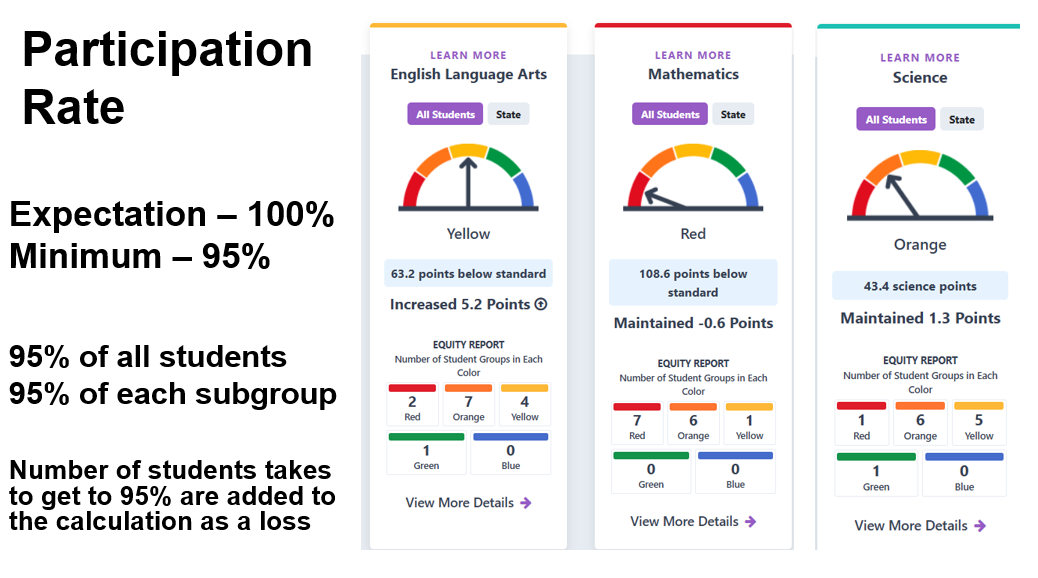
The state requirement for schools is to test 100% of students in the district that fall into the testing grade ranges. The minimum state requirement is 95% participation. This means that we must have 95% of all students and 95 of students in each subgroup complete the CAASPP assessment. If the 95% minimum is not met there can be penalties applied.
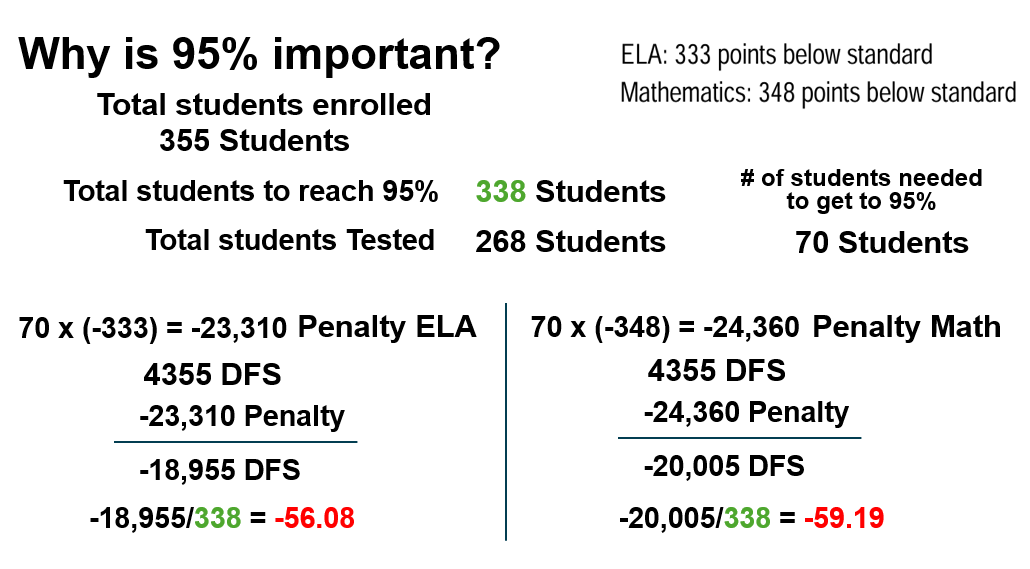
For every student not tested that it would take to meet the 95% minimum, a negative score penalty is applied. That negative score penalty directly impacts each school and district's CA Dashboard Indicators.
This same penalty applies to students with parent waivers
Penalties can include:
Lower status and color change
Increased oversite or
placement in CA Systems of support
Low public perception of the district and schools
Low participation can be perceived as low performance when penalties are applied.
See the image below which demonstrates how not meeting the 95% participation rate can take positive student test results into negative score and dashboard reporting.
The benefits of meeting the 95% participation rate include:
More accurate data about student learning
This allows for more accurate analysis of programs and curriculum which leads to better understanding of successes, learning gaps, and priorities.
Ratings reflect actual learning, not a lack of participation
Better access to resources and support.
Better perception and community trust
How can parents/guardians and families help prepare students?
Engage in activities with your student at home:
Practice Tests - practice tests are available online and can be accessed by parents and students at home to get familiar with the testing platform and work on practice questions.
I-Ready - students in grades 3-8 can access i-Ready lessons at home to practice and strengthen their skills
Play math games -
There are lots of math games that you can play with your student at home that reinforce and help students retain key math facts.
Use cards or dice to practice adding, subtracting, and multiplying
Have your student build a budget before grocery shopping, ask them to use their estimating skills while gathering items to determine if you are on budget.
Read 30 minutes nightly - students should read every night!
Build their reading stamina by steadily increasing minutes
Ask "w" questions about what they are reading -
Who is it about? Who are the characters? What do you know about them?
What did they do? What happened? What was the order of events?
Why did they do it? Why did the character make those choices? Why do you think the author wrote it that way?
When did it happen? What time period does the story take palace? How do you know?
Where is it at? Where do the events take place?
Ask questions that require students to male predictions, inferences, summarize, or draw conclusions -
What do you predict will happen next? What makes you think that?
Can you summarize the main events?
If you could change the ending, what would you change and why?
What is the author trying to tell or teach you by telling this story?
Do you agree with what they did? Why or Why not?
Ask questions that require students to connect and evaluate what they are reading -
Does this remind you of anything in your own life, another book, or movie you have seen?
What is your opinion? How would you rate this reading?
What questions do you still have after finishing the reading?
If you could ask the author one question, what would it be?
For Non fiction reading -
What are the key points the author wants you to remember?
What is the main point of this section?
Is the author trying to convince you to agree with them?
What evidence can you find to support that?
Why is this important?
What connections can you make to the real world or a personal experience?
Reach out to your child's teacher and/or counselor for additional practice work
Express a positive mindset
When it comes to testing, children take their emotional cues from the adults around them. A positive mindset at home can make all the difference in how they approach both preparation and test day. When parents stay calm, encouraging, and confident, students begin to see testing not as something scary, but as an opportunity to show what they know.
A supportive environment; simple things like celebrating effort, praising progress, and keeping routines steady, helps students feel safe and capable. When children believe they can succeed, they’re more willing to try, more resilient when challenges come up, and more focused during practice.
By modeling optimism and reassurance, parents help build a mindset that says, “I can do hard things.” That confidence doesn’t just improve testing experiences; it strengthens a child’s overall approach to learning and problem‑solving. In the end, a positive mindset at home becomes one of the most powerful tools a student carries into any test.
Prepare for testing days
Make sure students are ready to go for testing:
Ensure adequate sleep prior to testing days, a calm bedtime routine can make all the difference!
Ensure students eat a nutritious breakfast
Try to ensure a calm morning prior to testing - we know it can't always be avoided but rushing can cause students to feel frantic and increase test anxiety.
Encourage students to try their best
When is my school testing?
Elementary Schools
Elementary School | Content | Dates |
|---|---|---|
Belshaw Elementary | ELA, Math, Science | May 12 - 14, May 19 |
Carmen Dragon Elementary | ELA, Math, Science | May 4 - May 8 |
Diablo Vista Elementary | English Language Arts (ELA) | April 27 - May 1 |
Math | May 4 - May 8 | |
Science | May 11 - May 15 | |
Fremont Elementary | ELA, Math, Science | April 20 - May 1 |
Grant Elementary | ELA, Math, Science | April 13 - May 8 |
Kimball Elementary | 3rd Grade ELA | April 13 - April 23 |
3rd Grade Math | May 6 - May 15 | |
4th Grade ELA | May 5 - May 8 | |
4th Grade Math | May 18 - May 21 | |
5th Grade ELA | April 27 - April 29 | |
5th Grade Math | April 30 - May 4 | |
5th Grade Science | May 5 - May 6 | |
Jack London Elementary | ELA, Math, Science | April 13 - April 27 |
John Muir Elementary | ELA, Math, Science | April 20 - May 8 |
Lone Tree Elementary | ELA, Math, Science | April 13 - May 31 |
Marsh Elementary | English Language Arts | April 28 - April 30 |
Math | May 5 - May 7 | |
Science | May 12 - May 15 | |
Mission Elementary | ELA, Math, Science | May 4 - June 5 |
Orchard Park Elementary | 3rd Grade | April 27 - May 15 |
4th Grade | April 4 - May 1 | |
5th Grade | May 4 - May 29 | |
Sutter Elementary | English Language Arts | April 28 - April 30 |
Math | May 1 - May 5 | |
Science | May 6 | |
Thomas Gaines Elementary | ELA, Math, Science | April 20 - April 27 |
Turner Elementary | ELA, Math, Science | April 27 - May 13 |
Middle Schools
Middle School | Content | Dates |
|---|---|---|
Antioch Middle School | English Language Arts & Math | April 21 - April 24 |
Science | May 4 - May 8 | |
Black Diamond Middle School | English Language Arts | April 28 - May 7 |
Math | May 12 - May 14 | |
Science | May 18 - May 22 | |
Dallas Ranch Middle School | ELA, Math, Science | April 9 - May 8 |
Orchard Park Middle School | ELA, Math, Science | April 13 - May 21 |
Park Middle School | Science | April 13 - April 17 |
Math | April 20 - April 24 | |
English Language Arts | April 27 - May 1 | |
Thomas Gaines Middle School | English Language Arts | April 20 - April 21 |
Math | April 22 - April 23 | |
Science | April 24 |
High Schools
High Schools | Content | Dates |
|---|---|---|
Antioch High School | ELA, Math, Science | March 24 - March 26 |
Bidwell High School | ELA, Math, Science | April 14- April 16 |
Deer Valley High School | ELA, Math, Science | April 14 - April 17 |
Dozier Libbey Medical High School | ELA, Math, Science | April 13 - April 24 |
Live Oak High School | ELA, Math, Science | April 14 - April 17 |
Prospects High School | ELA, Math, Science | April 14 - April 16 |